Distributed energy
The Locational Value of Customer-Sited Energy Resources
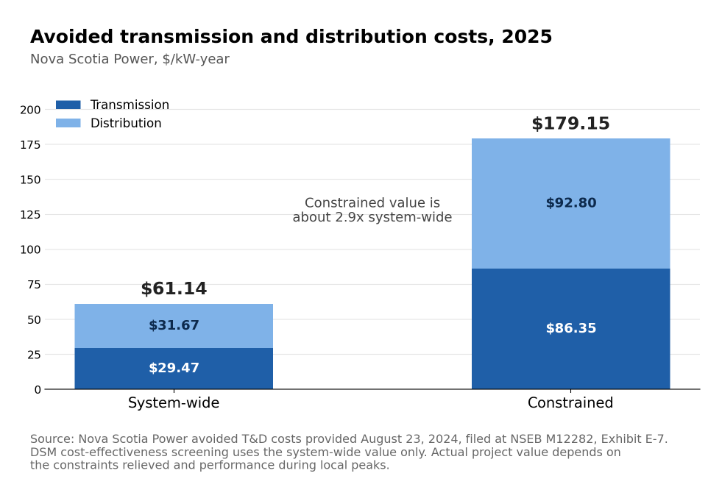
Customer-sited resources can defer local grid upgrades, with avoided transmission and distribution costs in constrained areas nearly three times the system-wide value.
Originally published on LinkedIn. This article reflects the information and perspective at the time of the original post.
Nova Scotia Power’s 2025 planning values put avoided transmission and distribution costs in constrained areas at $179.15 per kW-year, almost three times the system-wide value of $61.14.
When a feeder or substation approaches its limit, growing local peak demand can require new lines, transformers or substation capacity, and those costs are recovered through electricity rates. A customer-sited battery, efficiency upgrade or demand response program on the customer side of that bottleneck can reduce demand on the constrained equipment and delay or avoid the upgrade.
This is a real advantage over centralized resources. A large generator or transmission-connected battery can help meet system peak, but its power still travels through the local distribution network. Supplying more electricity upstream does not resolve a local distribution bottleneck. Reducing demand on the customer side of it can.
Actual savings depend on which upgrades can be deferred and whether resources reliably reduce demand during local peaks. Efficiency and demand response programs are currently assessed using the system-wide value. Targeting them to constrained areas is a known and promising area for future work. Unlocking it will take visibility into which parts of the grid are constrained, compensation mechanisms that reward dependable local peak reductions, and higher incentives for projects in those areas.
Recognizing locational value is an opportunity to get more from every dollar invested in customer-sited resources. It also helps ensure Nova Scotia builds the right mix of customer-sited and centralized resources, choosing each where it delivers the most value at the lowest cost. Using customer-sited resources to defer grid upgrades is known as a non-wires alternative, and Nova Scotia’s DER Integration Roadmap proposes a framework to do it. https://lnkd.in/giMv69ZW (opens in a new tab)